
Platform
One console for every charger you own.
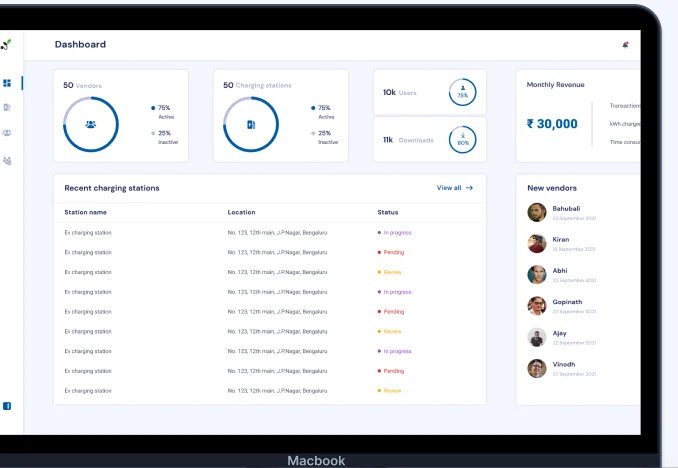
Sessions, hardware health, energy and money in a single system, across mixed fleets, multiple sites and more than one state.
The stack
Four layers, one console.
Read it from the ground up: the hardware you own, the work your team does on it, the energy it draws, and the money that comes back out.
- 01
Hardware
Any OCPP charger, any brand, mixed across the network. Vendor agnostic by design, because mixed fleets are the normal case.
- OCPP 1.6
- OCPP 2.0.1
- Mixed fleets
- No lock-in
- 02
Operations
Sessions, connector health, remote commands and remediation. The layer your team actually lives in.
- Live sessions
- Remote control
- Self-healing
- Role-scoped access
- 03
Energy
How much power is drawn, when, and against what the grid can carry at that moment.
- Smart charging
- Demand shaping
- Grid stability
- OpenADR
- 04
Commerce
Pricing, invoicing, settlement and the partner split, applied per transaction.
- T+3 settlement
- Automatic split
- Invoicing
- Reporting
Smart charging
Power is a budget, not a tap.
Charging on demand is straightforward until several vehicles arrive at once and your sanctioned load becomes the constraint. Smart charging shapes delivery across the site instead, so the network stays inside its limit and the distribution company on the other side of the meter stays predictable.
- Unmanaged
- Smart charging
Stay inside the sanctioned load
Demand is spread across connectors rather than delivered all at once, so a busy site does not exceed what it is contracted to draw.
Flatten the peaks that cost money
Demand charges follow your worst moment, not your average one. Reducing the peak is the cheapest saving available to a charging site.
Stay stable when everyone arrives together
Optimising against demand and grid conditions is what keeps a busy site from degrading into slow, unreliable charging.
Speak the grid's own language
OpenADR since 2025, on top of OCPI for interoperability across networks.
Self-healing
Your chargers fix themselves.
Faults are detected, diagnosed and remediated remotely. Most never reach a technician, and most never reach your customer.
- 01
Detect
The fault is raised the moment the connector reports it.
- 02
Diagnose
The system identifies the fault class without a site visit.
- 03
Remediate
A remote remediation runs and the connector returns to service.
- isolating affected circuit
- running diagnostic sweep
- fault class matched: GroundFailure
- issuing remote reset
- connector re-energised
Analytics
The numbers, without an export step.
Revenue trend, carbon footprint, transaction volume and monthly revenue on one surface. Where demand actually concentrates, on a heat map, rather than inferred from a spreadsheet at month end.
- Revenue trend01
- Where the money is going, over time and by site.
- Carbon footprint02
- What the network displaced, as a reportable figure.
- Transactions03
- Volume and value, per charger and per partner.
- Heat map04
- Where demand concentrates, which is where the next charger goes.
Roles and data
Everyone sees exactly what they should.
Role-based access is structural here rather than a setting somebody remembers to switch on. Operational data and customer information stay confined to the people whose job needs them.
Owner
The whole network, including commercial terms and payouts.
Operator
Sessions, charger health and remote commands. No commercial data.
Finance
Transactions, invoices, settlement and reporting.
Support
What is needed to answer a driver, and nothing beyond it.
| Role | Sessions | Charger health | Transactions | Payouts |
|---|---|---|---|---|
| Owner | Yes | Yes | Yes | Yes |
| Operator | Yes | Yes | No | No |
| Finance | No | No | Yes | Yes |
| Support | Yes | Yes | No | No |
Roles are configurable. This is the default shape, not a fixed one.
Integration
Onboarding is a few steps, not a project.
Adding a charger to the network is something your own team does. Manufacturers do it earlier still.
- 01
Register the charger
Identify the unit and the site it belongs to.
- 02
Pair it to the network
The charger connects over OCPP and reports itself.
- 03
Verify the connectors
Confirm each connector reports and responds as expected.
- 04
Go live
The charger is on the network, visible, and taking sessions.
- Charge point operator
- Onboarding a charger has never been this easy. No vendor visit, no integration project, no waiting on somebody else's roadmap.
- EV manufacturer
- Onboard to the CMS right in the assembly plant, so the unit reaches the site already part of a network.
Compatibility
Tested with the widest range of chargers.
The system is vendor agnostic. Mixed fleets are the normal case, not the exception, and nothing here assumes you bought all your hardware from one place.
- Charge point operator
- Onboarding a charger has never been this easy.
- EV manufacturer
- Onboard to the CMS right in the assembly plant.







Trademarks of their respective owners. Listed as tested compatibility, not as partnership or endorsement.
The network runs itself.
You collect.
Self-healing infrastructure, settlement on T+3, and charging that starts with a camera rather than a download. Bring us your network and we will show you it running.
- Speaks
- OCPP 1.6 · OCPP 2.0.1 · OCPI · OpenADR
- Phone
- 080 6217 8780
- Status
- Accepting demos